Quick answer: Most fridges don’t have a dedicated thermostat reset button. To reset a fridge thermostat, turn the temperature control to its off or zero position (or unplug the fridge), wait 5 to 10 minutes, then restore power and set the fridge to about 3 to 4°C and the freezer to about -18°C. On digital models, a reset usually means switching the unit off at the wall or holding a button combination shown in your manual. Allow 24 hours for the temperature to stabilise. If the fridge still isn’t cooling properly, the thermostat, temperature sensor or control board may be faulty and needs a technician.
If you’re in Quakers Hill or nearby Sydney suburbs, call Ace Fridge Repairs on 0452 462 556 and we’ll diagnose it for you.
What Does a Fridge Thermostat Actually Do?
The fridge thermostat is the temperature control that tells your compressor when to switch on and off. It monitors the internal temperature and keeps your cooling system working within a safe range.
The basic cycle works like this:
- The internal temperature rises above the set point.
- The thermostat (or temperature sensor) signals the compressor to start.
- The compressor and fans pull heat out of the cabinet.
- When the target temperature is reached, the thermostat switches the compressor off.
- The cycle repeats as heat slowly creeps back in.
If the thermostat or sensor gives wrong information, the fridge can run constantly, cool too much, or barely cool at all.
Recommended temperatures:
- Fridge compartment: 3 to 4°C
- Freezer compartment: -18°C
Below 5°C keeps food safe and slows bacterial growth. Above that, food spoils faster.
Types of Fridge Thermostats and Temperature Controls
The way you reset or adjust your fridge depends on the type of control it has.
1. Mechanical Thermostat Dial
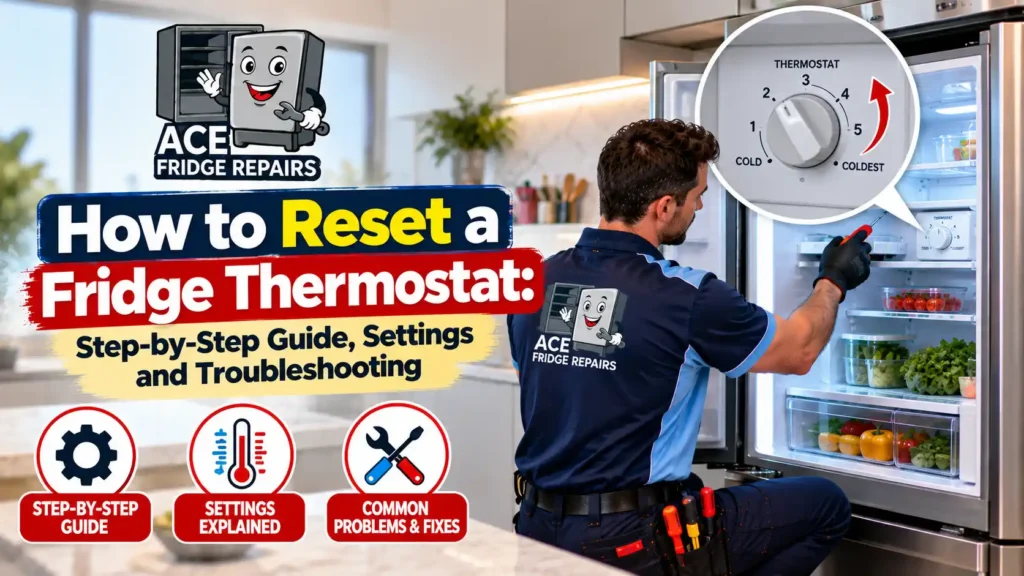
Older and budget fridges use a simple dial, usually numbered 1 to 7 (or marked from cold to coldest, sometimes with an “off” or “0” position). The dial is connected to a capillary tube or sensor that physically senses temperature and switches the compressor on and off.
Reset method: Turn the dial to off or zero, wait several minutes, then set it to a mid-range setting.
2. Digital Thermostat and Temperature Control Panel
Many modern fridges have a digital thermostat with buttons or a touchscreen on the door or inside the cabinet. The panel shows the set temperature, sometimes the actual temperature, and includes modes such as Super Cool, Holiday and Eco.
Reset method: Usually a power reset, or a button combination for factory reset (varies by brand).
3. Electronic Control Board with Temperature Sensor
High-end and inverter fridges use a refrigerator control board that reads one or more fridge temperature sensors (thermistors) and controls the compressor, fans and defrost system. There’s often no user-accessible thermostat at all.
Reset method: Power reset only. If the fault remains, the sensor or board likely needs replacing.
Is There a Fridge Thermostat Reset Button?
This is one of the most searched questions, so let’s be clear.
Most fridges do not have a thermostat reset button. What people call a “reset” is usually one of these:
- A power reset (switching off and on again)
- Turning the thermostat dial to off and back on
- A control panel reset on digital models (holding certain buttons)
- A compressor overload reset, where the compressor’s protective relay resets itself after cooling down
A few older fridges, some bar fridges and certain commercial units have a small red or black button on the thermostat itself, called a manual reset or high-limit switch. This is uncommon on modern domestic fridges. If your fridge has one, it’s usually inside the cabinet near the thermostat or behind the control housing, and pressing it should only be done with the power off. Check your manual first.
Read Also: Fridge Leaking Water in Winter? Common Causes and Repairs
Before You Reset: Quick Checks
Resetting won’t fix a problem that’s caused by something else. Check these first:
- Are the doors fully closed? A door left ajar makes the fridge run non-stop.
- Is the fridge plugged in and the power point working? Test the outlet with another appliance.
- Is the temperature set correctly? A dial accidentally bumped to the warmest setting is a common cause of a warm fridge.
- Is the fridge in Demo, Showroom or Shabbat mode? Some digital models have modes that disable normal cooling.
- Is the control panel locked? Many digital panels have a lock function that prevents changes.
- Are the vents blocked by food? Blocked airflow gives false temperature readings.
- Is there enough clearance around the fridge? Aim for a few centimetres at the back and sides.
How to Reset a Fridge Thermostat: Step by Step
Method 1: Power Reset (Works for Most Fridges)
This is the safest and most common way to reset a fridge thermostat or electronic control.
- Take out anything at risk. If you have ice cream, meat or other perishables, keep the doors closed as much as possible. A fridge stays cold for around 4 hours if unopened, and a full freezer for up to 24 to 48 hours.
- Turn the fridge off at the wall and unplug it. Never work near the back of the fridge with it plugged in.
- Wait at least 5 to 10 minutes. Some manufacturers suggest up to 30 minutes. This lets the electronics fully discharge and the refrigerant pressure equalise across the compressor.
- Plug the fridge back in and switch on.
- Set the temperature. Fridge about 3 to 4°C, freezer about -18°C.
- Leave the doors closed and wait. Give it 24 hours to reach and hold temperature before judging the result.
Important: Don’t rush the restart. Switching a compressor back on immediately after it’s turned off can trip its overload protector or strain the motor. Always wait at least 5 minutes.
Method 2: Resetting a Mechanical Thermostat Dial
- Turn the dial to the off or zero position. This stops the compressor.
- Wait 5 to 10 minutes.
- Turn the dial back to a mid-range setting (often 3 to 4 on a 1 to 7 scale).
- Wait 24 hours, then adjust in small steps if needed.
Tip: Adjust only one step at a time and wait a full day before changing it again. Fridges respond slowly, and big quick changes cause overshooting.
Method 3: Resetting a Digital Thermostat or Control Panel
Exact steps differ between brands, so always check your model’s manual. Common approaches include:
- Power reset first. Try Method 1.
- Hold the temperature or reset button for 3 to 10 seconds. Many panels reset or unlock when a specific button, such as “Lock”, “Alarm” or “Fridge/Freezer”, is held.
- Hold two buttons together (for example, Freezer + Fridge) for several seconds to reset to factory defaults.
- Switch off using the panel’s power or Eco mode, wait, then switch back on.
If a code or flashing light appears, note it down. Many fridges display error codes that point straight to a sensor or defrost fault, which is useful information for a technician.
Method 4: Compressor Overload Reset
If the compressor has overheated, it may have shut itself off. The overload protector usually resets automatically once the compressor cools, which can take 30 to 60 minutes. Unplugging the fridge and waiting one hour gives it the best chance to recover.
If the compressor repeatedly starts, clicks, then shuts down, that is a fault, not a reset issue.
How to Adjust Your Fridge Temperature Settings Correctly
Once the fridge has been reset, correct temperature settings are essential to good cooling performance.
Recommended Settings
| Compartment | Ideal Temperature |
|---|---|
| Fridge | 3 to 4°C |
| Freezer | -18°C |
| Crisper drawer | Slightly warmer, per drawer settings |
How to Check the Actual Temperature
Many fridges show only a set point, not the actual temperature. To verify:
- Place a fridge thermometer in a glass of water on the middle shelf.
- Leave it for at least 8 to 12 hours (overnight is ideal).
- Read the temperature without keeping the door open.
For the freezer, use a freezer-rated thermometer between packages.
How to Adjust
- Fridge too warm? Turn the dial up one step, or reduce the digital set point by 1°C. Wait 24 hours.
- Fridge too cold or freezing food? Do the opposite.
- Freezer temperature affects the fridge in many single-thermostat models, so adjusting the freezer setting can change the fridge temperature too.
Seasonal Adjustments
In Sydney’s hot summers, the kitchen can reach 30°C or more, and your fridge may need to be set one step colder. In winter, you may need to ease it back.
Fridge Thermostat Not Working: Signs and Symptoms
If a reset doesn’t help, the thermostat or temperature sensor may be faulty. Watch for:
- The fridge is too cold, with lettuce, milk or drinks freezing
- The fridge is too warm, even on the coldest setting
- The compressor runs constantly and never cycles off
- The compressor doesn’t start at all, even when the fridge is warm
- The compressor starts and stops erratically (short cycling)
- The dial or panel doesn’t change anything when adjusted
- The temperature display is wrong, blank or flashing
- The freezer is fine but the fridge is warm, or the reverse
- Control panel buttons are unresponsive
- Error codes appear on the display
Related guide: if your compressor never switches off, read our article on why a fridge runs all the time.
Common Reasons a Fridge Thermostat Reset Doesn’t Work
1. Faulty Mechanical Thermostat
Over time, the contacts inside a mechanical thermostat wear out or stick. It may stay stuck on (the fridge runs constantly and freezes food) or stuck off (the fridge never starts).
Solution: The thermostat needs replacing.
2. Faulty Temperature Sensor (Thermistor)
The temperature sensor is a small probe that reports the fridge’s internal temperature to the control board. If it drifts out of range or fails, the board gets false information and the fridge cools incorrectly.
Signs: Fridge too warm or too cold despite normal settings, fridge that runs continuously, fault codes.
Solution: Sensors are inexpensive components but require correct diagnosis, since a sensor problem can look just like a board problem.
3. Faulty Control Board
The refrigerator control board manages the compressor, fans and defrost system. Power surges, moisture and age can cause faults.
Signs: Erratic behaviour, unresponsive panel, problems that come and go, fans and compressor not working together.
Solution: Board repair or replacement by a technician.
4. Defrost System Problems
A failed defrost heater, defrost thermostat or timer allows ice to build up on the evaporator, blocking airflow. The fridge compartment then warms while the freezer remains cold. It looks like a thermostat issue but isn’t.
Signs: Frost on the back wall of the freezer, warm fridge, water pooling.
5. Evaporator or Condenser Fan Failure
If the evaporator fan fails, cold air doesn’t circulate. If the condenser fan fails, the compressor overheats. Both hurt cooling performance and can be confused with a thermostat fault.
6. Dirty Condenser Coils
Dirty coils reduce heat release, causing the fridge to run longer and warm up. Vacuum them gently with the fridge unplugged.
7. Worn Door Seals
Leaking door gaskets let warm air in constantly, which confuses the temperature control and makes the compressor run non-stop.
8. Low Refrigerant or Failing Compressor
If the cooling system has a refrigerant leak or the compressor is failing, no thermostat setting will fix the problem. The fridge runs but doesn’t cool.
Read Also: Fridge Running All the Time? Why Your Refrigerator Runs Constantly and How to Fix It
Fridge Not Cooling After Reset: What to Do
If your fridge isn’t cooling after a reset, work through this list:
- Wait a full 24 hours. It can take that long to stabilise, especially with a full freezer.
- Check the compressor. Can you hear it running or feel gentle vibration? If it’s silent, or clicks and stops, the compressor, relay or thermostat may be at fault.
- Check the fans. Listen for the fan inside the freezer and behind the fridge.
- Look for frost. A thick layer of ice at the back of the freezer means a defrost fault.
- Check the door seals with the paper test. Close a strip of paper in the door; if it slides out easily, the seal is weak.
- Clean the condenser coils.
- Check that the settings haven’t changed or aren’t locked.
- Verify the actual temperature with a thermometer.
If the fridge is still warm after all this, stop resetting it. Repeated resets can hide a developing fault and put extra strain on the compressor.
Fridge Thermostat Troubleshooting Guide
| Symptom | Likely Cause | What to Try |
|---|---|---|
| Fridge too warm, freezer fine | Evaporator fan, iced coils, blocked vents, defrost fault | Clear vents, check for frost, call a technician |
| Fridge too cold, food freezing | Faulty thermostat or sensor | Adjust the setting; if it persists, call for repair |
| Compressor never stops | Thermostat, sensor, dirty coils, door seal | Check coils and seals, then call a technician |
| Compressor won’t start | Thermostat, start relay, control board, compressor | Power reset; call a technician if it stays off |
| Display blank or wrong | Control panel or board fault | Power reset; call a technician |
| Settings won’t change | Panel lock or faulty control | Check lock mode, then reset |
| Fridge cycles on and off frequently | Faulty sensor, overloaded compressor, dirty coils | Clean coils; call a technician |
| Works after reset, fails again in days | Intermittent component failure | Book a diagnosis |
Can You Replace a Fridge Thermostat Yourself?
Technically, thermostat replacement is possible on some older fridges, but it isn’t a beginner’s job. Reasons to leave it to a technician:
- Electrical safety. Fridges run on mains power, and faulty work can cause electric shock or fire.
- Correct part matching. Thermostats and sensors are model-specific. The wrong one will cause incorrect temperatures.
- Capillary tube damage. On mechanical thermostats, the sensing tube must be positioned precisely. Bending or cutting it ruins the part.
- Misdiagnosis. Many “thermostat problems” are really sensor, board, fan or defrost faults. Replacing the wrong part wastes money.
- Warranty. DIY repairs can void your warranty.
Refrigerant work is legally restricted in Australia to licensed technicians, so anything involving the sealed system should never be attempted at home.
What NOT to Do When Resetting or Adjusting a Fridge Thermostat
- Don’t repeatedly switch the fridge on and off. This damages the compressor.
- Don’t restart within 5 minutes. Let the pressure equalise.
- Don’t turn the thermostat to the coldest setting to “speed up” cooling. It forces the compressor to run longer and can freeze food.
- Don’t force or over-tighten dials.
- Don’t remove covers or touch wiring while the fridge is plugged in.
- Don’t use sharp tools to chip ice or poke around inside the freezer. Puncturing the evaporator can cause a refrigerant leak.
- Don’t ignore a fridge that stays warm. Food safety is at risk above 5°C.
Food Safety While Your Fridge Is Being Fixed
If your fridge isn’t holding temperature:
- Keep the doors closed as much as possible.
- Move perishables into an esky (cooler) with ice packs if the fridge is above 5°C for more than 2 to 4 hours.
- Discard perishable foods (meat, dairy, cooked leftovers) that have been above 5°C for more than 4 hours.
- Frozen food that still has ice crystals or feels cold and hard can generally be safely refrozen, but when in doubt, throw it out.
When to Call a Professional
Book a fridge repairer if:
- The fridge won’t cool after a power reset and 24 hours
- The compressor runs constantly or won’t start
- The fridge is freezing food or running too warm
- The temperature control or panel doesn’t respond
- You see error codes or flashing lights
- There’s heavy frost or ice buildup
- The compressor or back of the fridge is extremely hot
- You hear clicking, buzzing or loud humming
- The problem returns after every reset
Ace Fridge Repairs tests thermostats, temperature sensors, control boards, fans, defrost components and compressors, so you get the right fix the first time rather than guessing.
What Happens During a Thermostat and Temperature Control Repair
Our technician will typically:
- Ask about symptoms and when they started
- Measure actual temperatures in the fridge and freezer
- Inspect door seals, airflow and clearances
- Test the thermostat or temperature sensor
- Test the control board and control panel
- Check the defrost system (heater, thermostat and timer)
- Test the evaporator and condenser fans
- Check compressor operation and electrical draw
- Look for signs of refrigerant leaks
- Explain the fault and repair options clearly before starting
Repair or Replace?
Repairing usually makes sense when:
- The fault is a thermostat, sensor, board, fan or door seal
- The fridge is under about 8 to 10 years old
- It’s a good-quality or built-in model
Replacing may be worth considering when:
- The compressor has failed on an older unit
- The sealed system is leaking
- Repair costs approach the price of a comparable new fridge
A thermostat or sensor repair is usually a modest cost compared with replacing a whole fridge.
Tips to Keep Your Fridge Thermostat Working Properly
- Set the fridge to 3 to 4°C and the freezer to -18°C and leave it there
- Avoid constantly changing the settings
- Keep the door seals clean and check them regularly
- Clean the condenser coils every 6 to 12 months
- Leave a gap of a few centimetres around the fridge
- Don’t overpack shelves or block vents
- Let hot food cool before refrigerating
- Use a surge protector to guard the control board against power spikes
- Have any unusual noises or temperature changes checked early
Fridge Thermostat Repairs in Quakers Hill and Surrounding Areas
Ace Fridge Repairs is a local repair service in Quakers Hill, helping households and businesses with thermostat faults, temperature control problems, poor cooling, constant running, ice buildup and more.
Ace Fridge Repairs
93B Pagoda Crescent, Quakers Hill NSW
Phone: 0452 462 556
Call us if your fridge:
- Doesn’t cool after a reset
- Is freezing food or running too warm
- Has a thermostat, dial or digital panel that won’t respond
- Runs constantly or won’t start
- Shows error codes or flashing lights
Frequently Asked Questions
How do I reset my fridge thermostat?
Turn the temperature control to off (or unplug the fridge), wait 5 to 10 minutes, then switch it back on and set the fridge to about 3 to 4°C and the freezer to about -18°C. Allow 24 hours to stabilise.
Does a fridge have a thermostat reset button?
Most don’t. A “reset” is usually a power reset, turning the dial off and on, or a button combination on digital models. A few older or commercial units have a manual reset button on the thermostat.
How long should I leave the fridge unplugged to reset it?
At least 5 to 10 minutes. Some manufacturers recommend up to 30 minutes. This protects the compressor and lets the electronics reset.
How do I reset a digital fridge thermostat?
Try a power reset first. If that doesn’t work, check your manual for a button combination, often holding the temperature, lock or reset button for several seconds.
How do I reset the fridge temperature?
Use the dial or control panel to set the fridge to 3 to 4°C and the freezer to -18°C, then wait 24 hours before making any further changes.
Why is my fridge not cooling after a reset?
It can take up to 24 hours to cool fully. If it doesn’t, the cause may be a faulty thermostat or sensor, a fan failure, an iced-up evaporator, a defrost fault, a control board problem or a refrigerant or compressor fault.
What temperature should my fridge thermostat be set to?
About 3 to 4°C for the fridge and -18°C for the freezer. On a numbered dial, a mid-range setting is usually the best starting point.
How do I know if my fridge thermostat is faulty?
Signs include food freezing, the fridge running too warm, a compressor that runs constantly or won’t start, and a dial or panel that has no effect.
Can I replace a fridge thermostat myself?
It’s not recommended. It involves electrical components, model-specific parts and a real risk of misdiagnosis. A qualified technician will test and replace the correct part safely.
Can resetting a thermostat damage my fridge?
No, if done properly. Just avoid restarting the compressor within 5 minutes of switching off, and don’t repeatedly cycle the power.
Why does my fridge keep freezing food?
A faulty thermostat or temperature sensor, or a setting that’s too cold, is the usual cause. If lowering the setting doesn’t help, get it checked.
Why is my fridge thermostat not responding?
The panel may be locked, the control board may have failed, or the dial or sensor may be faulty. Try a power reset first, then call a technician.
How much does it cost to replace a fridge thermostat?
It depends on the model and whether the fault is in the thermostat, sensor or control board. Call 0452 462 556 for a clear quote after diagnosis.
Need Help With Your Fridge Thermostat?
A reset is a good first step, but if your fridge still isn’t cooling properly, don’t keep guessing. Early diagnosis protects your food, your power bill and your compressor. Call Ace Fridge Repairs on 0452 462 556 or visit us at 93B Pagoda Crescent, Quakers Hill.