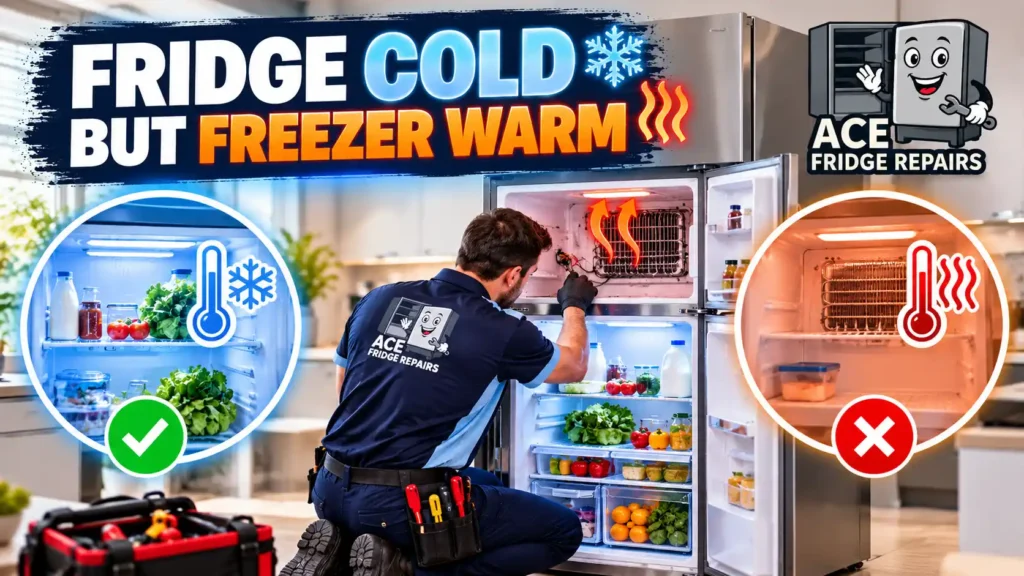
The milk is cold, the vegetables are crisp, the fridge section is behaving perfectly. Then you open the freezer and find soft ice cream, bendy chips, and a bag of frozen peas that has turned into a single solid lump from thawing and refreezing.
A fridge cold but freezer warm fault is the less common of the two uneven-cooling faults, and it is the more urgent one. Frozen food has a much shorter safety window than refrigerated food, and the fault list behind it includes issues that get worse the longer the appliance keeps running.
Ace Fridge Repairs handles domestic fridge repairs and commercial refrigeration across Sydney from a base at 93B Pagoda Crescent, Quakers Hill NSW 2763. If you have a warm freezer, call 0452 462 556 before the contents go past saving. The phones are open 24 hours a day, every day.
Fridge Cold But Freezer Warm: The Short Answer
In a conventional single-evaporator fridge, the cooling is generated inside the freezer and then shared into the fridge compartment. Logically, a warm freezer should mean a warm fridge as well. When that does not happen, it usually means one of two things.
Either the appliance has two separate cooling circuits, which is common in modern French door and side-by-side models, so a freezer-only fault is entirely possible. Or the cooling system is underperforming rather than dead, producing just enough cold for the fridge section but not enough to hold the freezer at minus 18.
Likely causes include a failing condenser fan, dirty condenser coils, a refrigerant charge problem, a freezer door that is not sealing, heavy frost on the evaporator, a stuck damper sending too much air to the fridge, a faulty freezer sensor, or a weak compressor.
This is the mirror image of the more familiar complaint where the fridge is not cooling while the freezer works, but the diagnosis path is genuinely different.
Why the Layout of Your Fridge Matters
Before working through causes, it helps to know which type of appliance you have, because a refrigerator cold but freezer warm fault is diagnosed differently on each.
Single evaporator (most top-mount and many bottom-mount fridges). One evaporator coil in the freezer, one fan, one air duct feeding the fridge. Because the cold is made in the freezer, a warm freezer with a cold fridge points to reduced overall system capacity or to air being diverted away from the freezer.
Dual evaporator or twin cooling (many French door and side-by-side models). Separate evaporator coils and fans for each compartment. Here a freezer-only fault is straightforward. The freezer evaporator, its fan, its defrost heater, or its sensor can fail while the fridge circuit carries on normally.
If you are not sure which you have, the model number and user manual will tell you, and a technician will identify it within minutes of opening the appliance.
Not sure what you are looking at? Phone Ace Fridge Repairs on 0452 462 556 and describe what you are seeing.
Common Reasons Your Fridge Is Cold But Freezer Warm
None of these can be confirmed without inspecting the appliance. Treat the list as a shortlist rather than a diagnosis, because a fridge cold but freezer warm symptom can have more than one cause at once.
1. Condenser fan failure
The condenser fan pushes air across the condenser coils to release heat from the system. When it seizes or slows, the whole system loses capacity. The fridge section, which only needs to reach around 3 or 4 degrees, often still manages. The freezer, which needs to reach minus 18, cannot. This is one of the most common causes of a warm freezer sitting above a cold fridge.
A clue is a compressor that runs almost constantly and a fridge that feels unusually warm underneath or behind.
2. Dirty or blocked condenser coils
Same effect, different cause. Dust, lint, and pet hair insulate the coils and stop heat escaping. Capacity drops, and the freezer is the first compartment to suffer because it has the harder job. Fridges installed in garages, laundries, or tight cabinetry accumulate this faster.
3. Refrigerant charge problems
A partial refrigerant loss or a restriction in the sealed system reduces how much of the evaporator coil actually gets cold. In a single-evaporator fridge, the result can be a coil that chills the air just enough for the fridge but not enough for the freezer. Sealed-system work is licensed work and cannot be assessed from the outside.
4. Freezer door seal failure or a door not closing
A perished, torn, or distorted freezer gasket lets warm humid air in continuously. The result is a warm freezer that never reaches temperature, frost builds up, and the problem accelerates. On models with an ice maker, a jammed ice bucket or a stray item can hold the door fractionally ajar without it looking open.
5. Frost or ice buildup on the freezer evaporator
If the defrost system has failed, frost thickens over the evaporator coil until air can no longer move through it. In dual-evaporator models this hits the freezer directly. The compartment gets warm even though the compressor is running, and you may hear the fan striking ice.
6. Defrost heater or defrost thermostat failure
These components exist specifically to clear that frost on a cycle. When the defrost heater, defrost thermostat, or the board function controlling them fails, ice accumulates until airflow stops. This is one of the most frequent repairable faults in frost-free appliances.
7. Freezer evaporator fan failure
In dual-evaporator models, the freezer has its own fan. If it fails, cold air is produced but never circulated through the compartment. The area immediately around the coil may be frozen while the rest of the freezer warms up.
8. Damper or diffuser stuck open
The damper controls how much cold air passes from the freezer into the fridge. If it sticks in the open position, too much cold air is diverted to the fridge compartment. You end up with an unusually cold fridge, sometimes cold enough to freeze items at the back, and a freezer that cannot hold temperature.
9. Faulty freezer thermistor or temperature sensor
The control board acts on what the sensors report. A freezer sensor reading incorrectly can convince the board that the compartment is already cold enough, so it stops calling for cooling. Everything sounds normal, nothing is obviously broken, and you are left with a warm freezer that simply drifts upward.
10. Overpacking and blocked freezer vents
Air has to circulate. A freezer packed solid to the back wall, or boxes pressed against the internal vents, creates warm pockets and uneven cooling. This is worth ruling out first because it costs nothing, and it is a surprisingly common reason for a freezer not freezing properly.
11. Control board faults
Less common, but a board can fail in ways that affect fan operation, defrost timing, or sensor interpretation while other functions keep working normally.
12. Compressor weakness
A compressor that is losing efficiency rather than failing outright can still deliver enough cooling for the fridge while falling short of freezer temperatures. This usually appears alongside long run times and poor recovery after the door has been opened.
If any of that matches your appliance, call Ace Fridge Repairs on 0452 462 556 to discuss it.
Safe Checks You Can Do First
These are safe for a homeowner and occasionally solve a fridge cold but freezer warm problem outright.
- Check the freezer setting. A freezer not freezing can simply be a setting that has been knocked, and some models reset after a power interruption. Aim for around minus 18 degrees.
- Check for a demo, showroom, or holiday mode. Some appliances have a display mode that limits cooling. The manual explains how to exit it.
- Test the freezer door seal. Close the door on a sheet of paper and pull. If it slides out freely, the seal is weak at that point. Test several spots around the door.
- Check the door is actually closing. Look for an overfull ice bucket, a drawer sitting proud, or a package holding the door open by a few millimetres.
- Unpack and check the vents. Move items away from the internal vents and the rear wall so air can circulate.
- Look for heavy frost. If there is a thick ice layer on the rear freezer wall or around the coil, that is a strong clue toward a defrost fault.
- Listen for the fans. You should normally hear air movement. Silence, grinding, or a ticking noise as blades strike ice all matter.
- Feel and inspect the condenser area. With the appliance switched off at the wall, check whether the coils at the rear or underneath are thick with dust, and vacuum them gently.
- Give the appliance clearance. Fridges need space at the rear and sides to shed heat. Tight cabinetry causes exactly this kind of capacity loss.
- Check the ambient temperature. A fridge in a hot garage or an unventilated alcove may be operating outside its rated range, especially through a Sydney summer.
If you still have a warm freezer after these checks, the fault is internal. Phone 0452 462 556.
What You Should Not Attempt
Some of the causes above sit firmly outside DIY territory:
- Do not open, cut, or attempt to recharge the sealed refrigerant system. Refrigerant handling in Australia requires a licence.
- Do not test or replace electrical components while the appliance is connected to power.
- Do not chip at ice with a knife or screwdriver. Puncturing an evaporator coil converts a repairable fault into a written-off appliance.
- Do not bypass a defrost thermostat, thermistor, or any safety device.
- Do not run the appliance with internal panels or covers removed.
Protecting Food in a Warm Freezer While You Wait
Frozen food has a shorter margin than refrigerated food, so act early.
- Keep the freezer door closed. A full, closed freezer holds temperature far longer than an empty or frequently opened one.
- Move the most valuable or most perishable items into an esky with ice bricks, or into a neighbour’s freezer.
- Food that still has ice crystals through it and is at or below 5 degrees can generally be refrozen, though texture may suffer.
- Food that has fully thawed and warmed should be cooked immediately or discarded. If you are unsure, discard it.
- Do not refreeze thawed raw meat, seafood, or poultry.
What a Technician Checks
When Ace Fridge Repairs attends a fridge cold but freezer warm call-out, the inspection typically covers:
- Measured temperatures in both compartments rather than the display reading
- Whether the appliance uses single or dual evaporator cooling
- Condenser coil condition and condenser fan operation
- Evaporator coil condition and frost levels
- Evaporator fan operation in each relevant compartment
- Defrost heater, defrost thermostat, and defrost cycle behaviour
- Damper or diffuser position and operation
- Thermistor and sensor readings against actual temperatures
- Freezer door seal condition, door alignment, and hinge wear
- Compressor performance and, where indicated, sealed-system pressures
- Control board behaviour and any stored fault codes
You then get a plain explanation of what has failed and what the repair involves. We work on all major makes, so check the brands we repair if you want to confirm yours.
Book a freezer repair inspection on 0452 462 556.
Repair or Replace?
Repair usually makes sense where the fault is a condenser fan, evaporator fan, defrost heater, defrost thermostat, damper, sensor, door seal, or control board, and the appliance is a mid-range or premium model that has otherwise performed well.
Replacement is more often considered where the fault is in the sealed system or the compressor on an older budget appliance, where parts are no longer available for that model, or where the fridge has already needed several unrelated repairs.
There is also a running cost angle. An appliance that is icing up and running almost continuously is drawing far more power than it should, every day it stays in that state.
For a warm freezer, a diagnosis puts a number on the choice instead of leaving it to guesswork.
Freezer Repair in Quakers Hill and Across Sydney
Ace Fridge Repairs is based at 93B Pagoda Crescent, Quakers Hill NSW 2763 and attends freezer repair and fridge repair jobs across Sydney. Customers in Quakers Hill, Schofields, Marayong, Kings Park, Acacia Gardens, Stanhope Gardens, Blacktown, Seven Hills, Kellyville, Rouse Hill, Castle Hill, Bella Vista, and surrounding suburbs can call to discuss availability. You can see the full list of suburbs we service across Sydney.
Sydney conditions matter here more than most people expect. Humid summers drive frost buildup and load the defrost system. Fridges placed in garages, enclosed laundries, and sun-facing alcoves routinely run above their rated ambient range, and the freezer is always the compartment that shows the strain first.
The same capacity logic applies to commercial equipment. A display fridge, underbench freezer, or coolroom losing temperature follows a similar diagnostic path through our commercial refrigeration repairs service, but the consequences and the timeframes are very different when stock is at risk.
What Sort of Appliance Is It?
- Household fridge freezer. Standard domestic fridge repairs call-out and diagnosis.
- Chest freezer or upright freezer. Standalone units with their own common fault patterns, including a freezer not freezing even while the compressor runs.
- Commercial display fridge or underbench freezer. Treated as priority work, since downtime means stock loss.
- Coolroom or freezer room. Larger systems handled separately from domestic work through our coolroom repairs service.
Whichever it is, call Ace Fridge Repairs on 0452 462 556 and describe the symptoms.
Frequently Asked Questions
Why is my fridge cold but the freezer warm?
It usually means the cooling system is underperforming rather than failing completely, or that the appliance has separate cooling circuits and only the freezer circuit has a fault. Likely causes include a failing condenser fan, dirty condenser coils, a refrigerant charge problem, a freezer door seal failure, heavy frost on the evaporator, a stuck damper, or a faulty freezer sensor.
Is a warm freezer more urgent than a warm fridge?
Generally yes. Frozen food has a shorter safety margin once it starts thawing, and several of the underlying causes, such as ice buildup and condenser fan failure, get progressively worse while the appliance keeps running. Keeping the door shut and arranging an inspection early limits both food loss and repair scope.
Can a freezer be warm if the compressor is still running?
Yes, and it is common. A compressor that runs constantly while the freezer stays warm often points to lost system capacity, such as a condenser fan fault, blocked coils, or a refrigerant problem, or to airflow being blocked by frost. Constant running with poor results is a symptom worth reporting to a technician.
Why is my freezer not freezing but the fridge is cold?
The freezer needs to reach a much lower temperature than the fridge, so it fails first whenever overall cooling capacity drops. It can also happen when cold air is diverted away from the freezer by a stuck damper, or when the freezer evaporator fan or defrost system has failed on a dual-evaporator model.
Can a door seal really cause a warm freezer?
Yes. A perished or distorted gasket allows warm humid air in continuously. The compartment never reaches temperature, frost accumulates on the evaporator, and the airflow problem compounds the original leak. A paper test around the door will show whether the seal is holding.
Will defrosting the fridge fix it?
Manually defrosting can restore normal operation for a few days if ice was blocking airflow. It does not fix the reason the ice formed. If the freezer warms up again within a week or so, a defrost system component has almost certainly failed and needs replacing.
Can I refreeze food that has thawed?
Food that still contains ice crystals and has stayed at or below 5 degrees can generally be refrozen, though the texture may change. Fully thawed raw meat, poultry, and seafood should be cooked straight away or discarded. When in doubt, throw it out.
How much does freezer repair cost?
It depends entirely on the fault, the parts required, and the appliance. A fan, sensor, or defrost component replacement sits at a very different price point to a sealed-system repair. The practical step is a diagnosis first, then a decision. Call Ace Fridge Repairs on 0452 462 556 to discuss it.
Should I repair or replace a fridge with a warm freezer?
Repair is usually worthwhile for component-level faults such as fans, defrost parts, dampers, sensors, or seals, particularly on mid-range and premium appliances. Replacement is more often considered for sealed-system or compressor failures on older budget models, or where parts are no longer available.
When should I call a fridge technician?
Call once the basic checks have not helped, or immediately if you can see heavy frost buildup, hear grinding or ticking from inside, notice the compressor running non-stop, or find the freezer temperature still rising. Ace Fridge Repairs can be reached on 0452 462 556.
Freezer Climbing While the Fridge Stays Cold? Get It Diagnosed Before the Stock Is Lost
Ace Fridge Repairs handles domestic and commercial refrigeration faults across Sydney, including warm freezers, fridges that are not cooling, frost and ice buildup, water leaks, noisy compressors, and appliances that will not switch on.
Ace Fridge Repairs
93B Pagoda Crescent, Quakers Hill NSW 2763
0452 462 556
Open 24 hours a day, every day