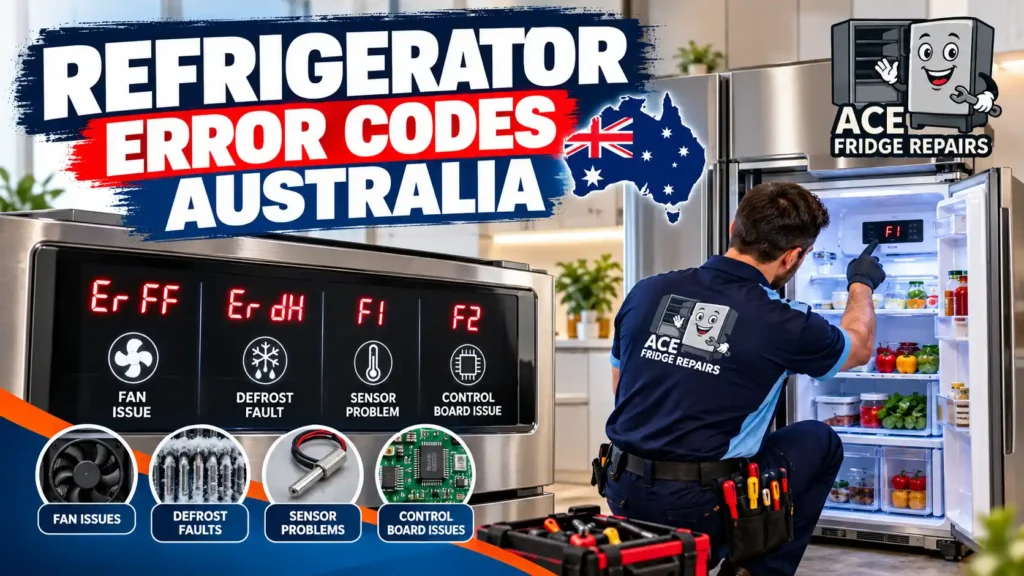
Your fridge is beeping. The display that normally shows a temperature is now showing something like E1, dF, F2, or a sequence of flashing lights. Nothing in the kitchen has obviously broken, but the appliance is clearly telling you something.
Modern refrigerators run continuous self-diagnostics. When a sensor reading falls outside expected limits, a fan stops turning, or two components stop communicating, the control board logs a fault and puts a code on the display. That code is the appliance narrowing the problem down for you.
The catch, and it is the single most important thing to understand before you go searching, is that fridge error codes are model specific, not universal. The same two characters can mean completely different things on two appliances from the same manufacturer, let alone across brands.
This guide to fridge error codes Australia-wide explains how to read the code your appliance is showing, what the main fault families generally indicate, what you can safely check, and when to call a technician.
Ace Fridge Repairs handles domestic fridge repairs and commercial refrigeration across Sydney from 93B Pagoda Crescent, Quakers Hill NSW 2763. If your fridge is showing a code and you want it interpreted properly, call 0452 462 556. The phones are open 24 hours a day, every day.
Fridge Error Codes Australia: The Short Answer
A fridge error code is a fault reference generated by the appliance’s control board when a self-check fails. It tells a technician which subsystem reported the problem, not what the repair is.
Fridge error codes most commonly relate to temperature sensors and thermistors, the defrost system, fan motors, communication between the control board and the display, door switches and door alarms, the water and ice system, or the compressor and inverter drive.
Because code tables are set by the manufacturer for each model line, the only reliable lookup is your own appliance’s manual or service documentation, identified by the full model number on the rating plate. Third-party code lists found online are frequently wrong for a given model.
Step One: Write the Code Down Exactly
Before doing anything else, record the error code precisely as you see it. This matters more than people expect.
- Note whether it is a letter and a number, two letters, or a number alone.
- Note the case. Some displays distinguish between
dFandDF. - Note whether it is steady or flashing, and whether it alternates with a temperature reading.
- Note whether the appliance is also beeping, and whether the beeping is continuous or intermittent.
- Note which compartment’s display is showing it, on models with two displays.
- Photograph the display with your phone. Codes sometimes clear before the technician arrives, and a photo preserves the evidence.
On appliances without a digital display, the fault is often shown as a flash pattern on an LED or on the temperature indicator lights. Count the flashes and note the pause length. Three flashes, pause, three flashes is a different fault to a continuous rapid flash.
Have the code and the model number ready, then phone Ace Fridge Repairs on 0452 462 556.
Step Two: Find Your Model Number
Fridge error codes are meaningless without the model. On Australian appliances the rating plate is usually in one of these places:
- Inside the fridge compartment on a side wall, often low down near the crisper
- On the inside edge of the door frame, visible when the door is open
- On the rear of the cabinet, near the compressor compartment
- Underneath, on the base or kick plate
- Inside the freezer compartment on some upright models
The plate carries the model number, serial number, and usually the electrical rating. The model number is the long one, and it often includes suffixes that matter. Two appliances with the same first six characters can use different control boards and different code tables.
For commercial cabinets, the plate is commonly on the rear, inside the door frame, or on the condensing unit housing.
Why There Is No Universal Fridge Error Codes List
This is where most online code lists fall over.
Manufacturers assign error codes per model platform. A code table written for one generation of an appliance may not apply to the next generation of the same product name. Manufacturers also revise tables mid-production, and appliances built for the Australian market sometimes differ from their overseas equivalents.
On top of that, many error codes are service codes rather than consumer codes. They exist to tell a technician which test to run next, not to describe a finished diagnosis. A code pointing at a temperature sensor circuit, for example, might be caused by a failed thermistor, a damaged wiring harness, a connector that has corroded, or a control board input that has failed. All four produce the same code.
So the error code is a starting point. It narrows a technician’s diagnostic path from a dozen possibilities to two or three, which is genuinely valuable, but it is not a repair instruction.
Want the code interpreted against the actual appliance? Call 0452 462 556.
The Main Fault Families Behind Fridge Error Codes
While the error codes themselves vary, the subsystems they report on are consistent across nearly all modern refrigerators. Understanding these families tells you roughly how worried to be.
Temperature sensor and thermistor faults
The most common family of fridge error codes by a wide margin. The board monitors thermistors in the fridge compartment, the freezer, and often on the evaporator itself. A reading that is open circuit, short circuit, or implausible triggers a code.
Symptoms often include compartments running too warm or too cold, or the appliance not cooling at all despite sounding normal, because the board is acting on bad information.
Defrost system faults
Error codes in this family generally indicate that a defrost cycle did not complete as expected, or that the evaporator temperature did not rise the way it should have during defrost. Underlying causes include a failed defrost heater, a failed defrost thermostat or bi-metal, or a sensor fault.
Left unattended, this produces heavy frost buildup on the evaporator, which blocks airflow and causes uneven cooling between compartments.
Fan motor faults
Evaporator and condenser fan motors on many modern appliances report their speed back to the control board. If the fan stalls, slows, or stops reporting, a code is logged. Common causes are a seized motor, a blade striking ice, or a wiring fault.
A condenser fan fault typically shows up as poor cooling in the freezer first, leaving the freezer warm while the fridge stays cold. An evaporator fan fault usually shows up as a warm fridge compartment, the classic case of a fridge not cooling but the freezer works.
Communication faults
On appliances where the display panel and the main board are separate, they talk to each other over a data line. If that connection fails, a communication code appears. The display may go blank, freeze, or show a code while the appliance keeps cooling normally. Causes range from a loose connector to a failed board.
Door switch and door alarm codes
These indicate the appliance believes a door has been open too long. Sometimes it is correct and something is holding the door ajar. Sometimes the door switch itself has failed, or a hinge has dropped and the door is not compressing the seal fully.
Water and ice system faults
On models with plumbed water, ice makers, or dispensers, error codes may relate to the inlet valve, the water line, a frozen fill tube, or the ice maker motor. These are often non-urgent, in that the fridge keeps cooling, but they will not clear themselves.
Compressor and inverter faults
Inverter-driven compressors, now common across most modern appliances, have their own drive electronics that report faults. These error codes are the ones that most often indicate a significant repair. Symptoms usually include the appliance not cooling at all, or cycling on and off rapidly.
Safe Checks You Can Do Before Calling
None of these are guaranteed fixes, but they are safe and they occasionally clear transient error codes.
- Check the doors. Make sure nothing is holding a door or drawer open, including an overfull ice bucket or a package on a shelf edge.
- Check the power supply. Loose plugs, extension leads, and power boards cause voltage issues that trigger spurious codes. Plug the appliance directly into a wall outlet where possible.
- Power cycle the appliance. Switch it off at the wall, wait around five minutes, then switch it back on. Some codes are transient and will not return. If the same code reappears within a day, the fault is real.
- Check the temperature settings and look for a demo, showroom, or holiday mode that may have been activated accidentally.
- Look for visible frost or ice on the rear freezer wall or around the evaporator area.
- Clear the vents. Move food away from internal air vents and away from the rear wall.
- Vacuum the condenser coils at the rear or underneath, with the appliance switched off at the wall first.
- Check the manual. If you still have it, the code table for your exact model is in it. Most manufacturers also publish manuals by model number on their Australian support sites.
If the code returns after a power cycle, the appliance has a genuine fault. Phone 0452 462 556.
What You Should Not Do
- Do not ignore a code because the fridge still seems to be working. Defrost and fan faults in particular get worse steadily, and the repair gets larger as frost accumulates.
- Do not repeatedly reset the appliance to clear the display. You are hiding the symptom, not fixing the fault, and you may lose the stored fault history a technician would use.
- Do not enter service or diagnostic mode by following a button sequence found online. Service modes can override defrost cycles, force compressor operation, and change factory settings. Appliances have been damaged this way.
- Do not open the sealed refrigerant system. Refrigerant handling in Australia requires a licence.
- Do not test or replace electrical components while the appliance is connected to power.
- Do not act on a code meaning from a generic online list without confirming it against your model. This is how people replace the wrong part.
Error Codes on Commercial Refrigeration
Commercial cabinets work differently and this trips people up.
Many commercial fridges, display cabinets, underbench units, and coolrooms do not use a manufacturer-specific code table at all. Instead they use a third-party electronic controller, and the error codes belong to the controller, not the cabinet.
That means the code you are reading may be documented by the controller manufacturer rather than the brand on the door. A technician will identify the controller model from the faceplate and work from that documentation.
Commercial error codes also carry higher stakes. A high-temperature alarm on a display fridge or coolroom is a stock loss event in progress, not a maintenance reminder. These should be treated as urgent, and our commercial refrigeration repairs and coolroom repairs are handled as priority work.
If a commercial unit or coolroom is alarming, call Ace Fridge Repairs on 0452 462 556 straight away.
Which Brands Show Error Codes?
Effectively all modern refrigerators with electronic controls do, including appliances from LG, Fisher & Paykel, Westinghouse, Electrolux, Bosch, Hisense, Haier, Whirlpool, Smeg, Miele, Hitachi, Panasonic, Mitsubishi Electric, Kelvinator, CHiQ, Beko, Omega, Devanti, and Skope, along with most commercial refrigeration brands.
What differs between them is the format. Some use a letter and number combination. Some use two letters. Some use numbers alone. Some display the code only in a diagnostic mode rather than on the main display, and some older or lower-cost models communicate faults purely through flashing indicator lights.
Ace Fridge Repairs works on all major residential and commercial refrigeration brands, with fully equipped service vans and genuine spare parts carried on board. You can see more about the brands we repair.
What a Technician Does With the Code
An error code shortens the job, it does not replace the diagnosis. A technician attending a coded fault will typically:
- Confirm the code and read any stored fault history from the control board
- Identify the exact model and the applicable code table
- Measure actual temperatures in both compartments rather than trusting the display
- Test the sensors the code implicates, checking resistance against expected values
- Inspect the wiring harness and connectors in that circuit, since connector faults mimic component faults
- Check fan operation, evaporator frost levels, and defrost cycle behaviour
- Test the implicated component directly before replacing anything
- Confirm the fault has cleared and does not return under normal operation
That last step matters. Replacing a part because a code pointed at it, without testing, is how the same fault comes back a fortnight later.
Repairs carried out by Ace Fridge Repairs use genuine manufacturer parts and are backed by a 12 month warranty on parts and workmanship.
Fridge Repairs in Quakers Hill and Across Sydney
Ace Fridge Repairs is based at 93B Pagoda Crescent, Quakers Hill NSW 2763 and attends refrigeration repairs across Sydney. Customers in Quakers Hill, Schofields, Marayong, Kings Park, Acacia Gardens, Stanhope Gardens, Blacktown, Seven Hills, Kellyville, Rouse Hill, Castle Hill, Bella Vista, and surrounding suburbs can call to discuss availability. You can see the full list of suburbs we service across Sydney.
Sydney’s humid summers put real load on defrost systems, and defrost-related error codes become noticeably more common through the warmer months. Appliances installed in garages, enclosed laundries, and sun-facing alcoves often run above their rated ambient range, which produces both genuine faults and sensor readings the control board treats as faults.
Have the error code and the model number handy when you call. It genuinely speeds things up.
Frequently Asked Questions
What does my fridge error code mean?
It depends entirely on your model. Codes are assigned by the manufacturer per model platform, so the same characters can mean different things on different appliances. Most codes fall into one of a few families: temperature sensor faults, defrost system faults, fan motor faults, communication faults, door alarms, water system faults, or compressor and inverter faults. Confirm against your model’s manual, not a generic list.
Can I reset a fridge error code?
You can power cycle the appliance by switching it off at the wall for around five minutes. If the code was transient it may not return. If the same code reappears, the fault is real and resetting repeatedly only hides it. Avoid entering service or diagnostic mode using button sequences found online.
Is a fridge error code serious?
It varies. A door alarm or water system code may not affect cooling at all. A defrost or fan fault worsens steadily and will eventually cause uneven cooling. A compressor or inverter code usually indicates a significant repair. On commercial equipment, a high-temperature alarm should always be treated as urgent.
Why is my fridge showing an error code but still working?
Many faults do not stop the appliance cooling immediately. A communication fault between the display and the control board, a door switch fault, or an ice maker fault can all log a code while the fridge keeps running. The code is an early warning, and acting on it early usually keeps the repair smaller.
Why is my fridge flashing lights instead of showing a code?
Appliances without a digital display often report faults through a flash pattern on an indicator LED or on the temperature setting lights. Count the number of flashes and note the pause between sequences, because the pattern is the code. Photograph or video it if you can.
Where do I find my fridge model number?
Check the rating plate, usually inside the fridge compartment on a side wall, on the inside door frame, on the rear of the cabinet, or underneath on the base. Use the full model number including any suffix, since suffixes often indicate a different control board and a different code table.
Do all fridge brands use the same error codes?
No. There is no industry standard. Formats differ, code meanings differ, and manufacturers revise their tables between model generations. Codes from an overseas version of the same appliance may not match the Australian model either.
Can a sensor error code mean something other than a failed sensor?
Yes, and this is a common trap. A sensor circuit code can be caused by a failed thermistor, a damaged wiring harness, a corroded connector, or a failed input on the control board. All produce the same code, which is why testing before replacing matters.
Should I keep using my fridge while it shows a code?
If it is still holding correct temperatures, you can generally keep using it while you arrange a repair, but do not leave it indefinitely. If temperatures are drifting, move perishable food and arrange an inspection promptly.
When should I call a fridge technician about an error code?
Call once the code has returned after a power cycle, or straight away if the appliance is not holding temperature, there is visible frost buildup, the compressor is running constantly, or a commercial unit is alarming. Ace Fridge Repairs can be reached on 0452 462 556.
Fridge Showing a Code You Cannot Decipher? Have It Read Properly
Ace Fridge Repairs diagnoses coded faults on domestic and commercial refrigeration across Sydney, including sensor and thermistor faults, defrost system failures, fan motor faults, control board issues, and compressor problems. Repairs use genuine manufacturer parts and carry a 12 month warranty on parts and workmanship.
Have your model number and the code ready when you call.
Ace Fridge Repairs
93B Pagoda Crescent, Quakers Hill NSW 2763
0452 462 556
Open 24 hours a day, every day