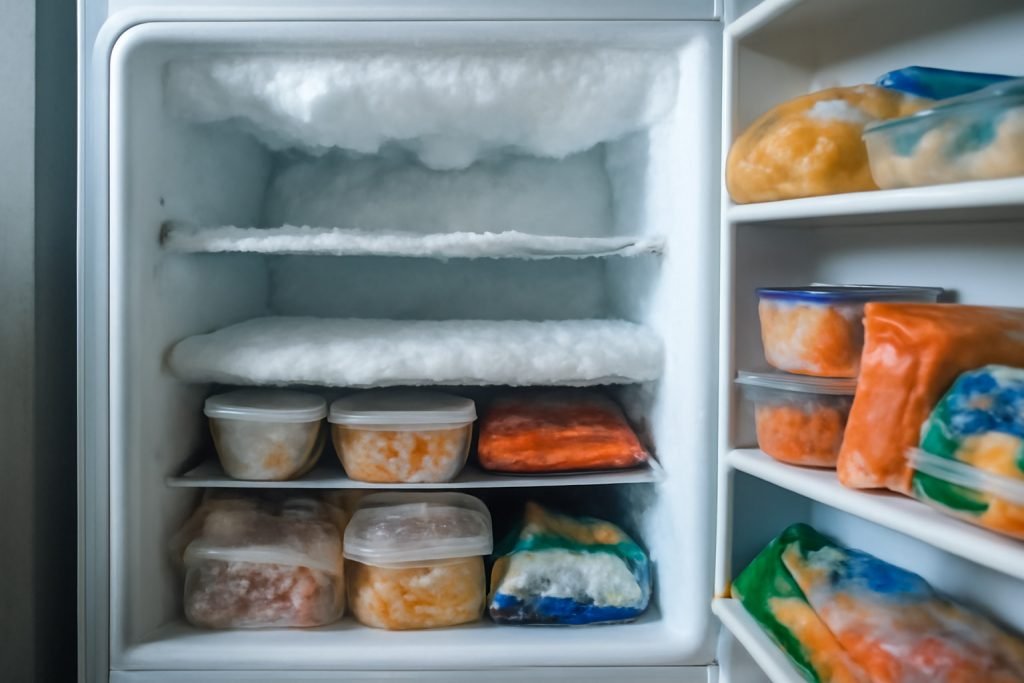
A thin layer of frost in a freezer is not unusual, especially in older manual-defrost models. Thick frost on the back wall, ice around the fan cover, frost on food packets or a fridge that has started freezing lettuce and milk are different stories. They usually point to warm air getting in, poor airflow or a fault in the defrost or temperature control system.
This guide explains why frost builds up in a freezer, why a fridge can start freezing everything, what you can check at home and when you need a technician.
Frost Build-Up in the Freezer: The Short Answer
In a frost-free freezer, heavy frost usually means the defrost system has failed (a defrost heater, defrost thermostat or sensor, timer or control board) or warm, humid air is getting in through a worn door seal or a door that is not closing fully. Frost on food packets and inside the door is typically a seal or door problem. Frost concentrated on the back wall or fan cover is typically a defrost fault. If the fridge section is also freezing food, the temperature setting, a faulty sensor or a stuck air damper is usually to blame.
Where the Frost Is Tells You the Cause
- Frost on the back wall or evaporator cover: defrost system fault.
- Frost around the door opening and on food packets: worn seal, door left ajar, or the door not closing because something is in the way.
- Frost all over after a power outage or long door opening: usually a one-off; defrost the freezer and monitor.
- Frost in a manual-defrost chest or upright freezer: normal build-up that needs regular manual defrosting.
Common Causes of Frost Build-Up
Defrost system failure
Frost-free fridges melt frost off the evaporator coils several times a day using a defrost heater, controlled by a timer or control board and protected by a defrost thermostat or sensor. If any of these fails, frost keeps building until it blocks airflow. The freezer may still feel cold at first, but the fridge section usually warms up because cold air can no longer circulate. Our guide on a fridge not cooling while the freezer works explains this pattern.
Worn or dirty door seal
A seal that is torn, flattened or greasy lets warm, moist air in. That moisture freezes on the coldest surfaces, which is why frost often appears around the door and on packaging near the front.
Door not closing fully
An overfilled freezer drawer, a bag of peas caught in the door or a fridge tilted forward can stop the door sealing. Most fridges should sit slightly higher at the front so the doors swing shut.
Blocked air vents
Packing food against the vents disrupts airflow, creating cold spots where frost forms and warm spots where it does not.
Blocked defrost drain
If defrost water cannot drain, it refreezes at the bottom of the freezer or back wall, forming a sheet of ice.
Frost keeps coming back? Call Ace Fridge Repairs on 0452 462 556 and we can test the defrost system properly.
Why Is My Fridge Freezing Everything?
When the fresh food section starts freezing milk, eggs and salad, check these causes:
- The temperature setting is too cold. A fridge section should generally sit around 3 to 5 degrees Celsius. Check both the fridge and freezer settings, as some models share controls.
- A faulty temperature sensor or thermistor. If it reads warmer than reality, the fridge keeps cooling.
- A stuck air damper. Many fridges use a damper to let cold air from the freezer into the fridge. If it sticks open, too much cold air flows through.
- Food stored against the cold air vent. Items directly in front of the vent often freeze even when the rest of the fridge is fine.
- A faulty control board or thermostat. The compressor may run far longer than it should.
Our guide on how to reset a fridge thermostat walks through checking and adjusting the settings.
What You Can Do at Home
- Check the settings. Make sure the fridge and freezer are not set colder than needed.
- Test the door seal. Close the door on a sheet of paper. If it slides out easily, the seal is not doing its job. Clean it with warm soapy water.
- Check the door closes. Rearrange items so nothing stops the door or drawers closing.
- Keep vents clear. Leave space around the air vents in both compartments.
- Defrost fully. Switch the fridge off at the wall, remove food to an esky, leave the doors open and place towels down. Never chip ice with a knife or sharp tool, as it can puncture the evaporator.
- Monitor. If heavy frost returns within a few days or weeks, the defrost system needs a technician.
Why You Should Not Ignore Frost Build-Up
Heavy frost makes the fridge run longer, pushes up power bills, reduces storage space and can lead to temperature swings that affect food safety. As general guidance, perishable food should stay at 5 degrees Celsius or below. For food safety advice, refer to the NSW Food Authority.
For businesses, frost build-up in display freezers and coolrooms often leads to stock losses if left too long.
How We Fix Frost Build-Up
Our technicians remove the evaporator cover, check the ice pattern, then test the defrost heater, defrost thermostat or sensor, timer or control board, and drain. We also check the seals, door alignment, fans and damper. Repairs are explained before work begins and backed by a 12-month warranty on parts and labour.
Frost and Freezer Repairs Across Sydney
Ace Fridge Repairs is based at 93B Pagoda Crescent, Quakers Hill NSW 2763 and services household fridges, commercial freezers and commercial refrigeration across Greater Sydney. See the suburbs we service and the brands we repair.
Call 0452 462 556, 24/7.
Frequently Asked Questions
Why is there so much frost in my freezer?
In a frost-free freezer, heavy frost usually means the defrost system has failed or warm air is getting in through a worn seal or a door that is not closing properly. Frost on the back wall points to defrost; frost near the door points to the seal.
Is frost build-up in a frost-free freezer normal?
No. A frost-free freezer should stay largely free of visible frost. Heavy or recurring frost means a part of the defrost system or the door seal needs attention.
Why is my fridge freezing food in the fresh section?
The setting may be too cold, food may be blocking the cold air vent, or a temperature sensor, air damper or control board may be faulty.
How do I defrost my freezer safely?
Switch it off at the wall, move food to an esky, leave the doors open and put towels down. Let the ice melt naturally. Do not use knives or sharp tools, which can puncture the evaporator.
Can I keep using a freezer with frost build-up?
For a short time, yes, but performance will drop and power use will rise. If frost returns quickly after defrosting, book a repair.