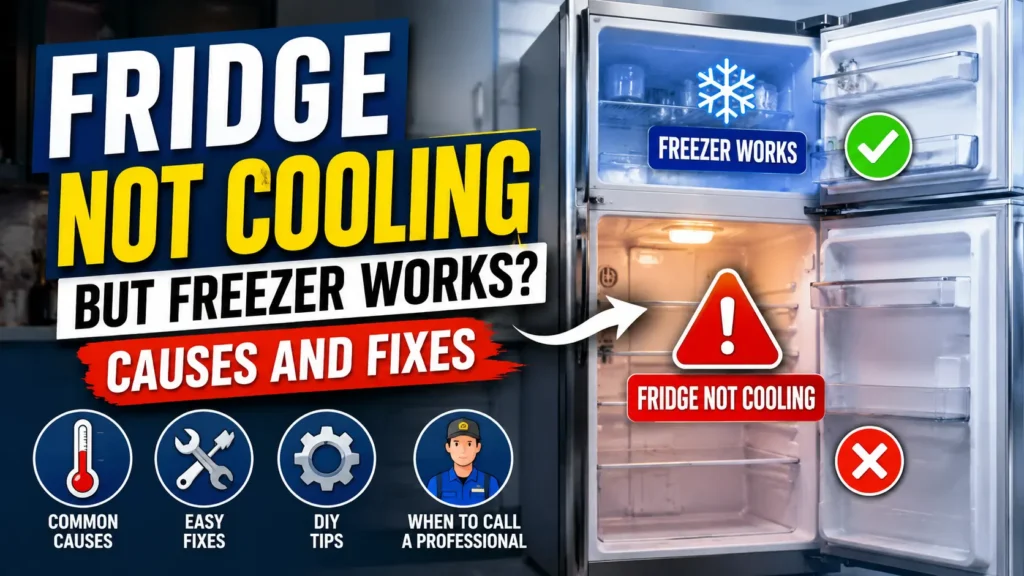
It is one of the strangest faults a fridge can develop. The freezer is rock solid, the ice cubes are fine, the frozen peas are frozen. But the milk in the fridge section is going off, the salad is limp, and the top shelf feels barely cooler than the kitchen.
If your fridge is not cooling but the freezer works, the appliance has not simply “half died”. In most modern refrigerators this symptom points to a specific and very common group of faults, and several of them are repairable. This guide explains why it happens, what you can safely check yourself, and when it is time to bring in a technician. If you are dealing with the opposite fault, where the freezer is warm but the fridge is cold, that has its own set of causes.
Ace Fridge Repairs services domestic and commercial refrigeration across Sydney from a base at 93B Pagoda Crescent, Quakers Hill NSW 2763. If you would rather skip straight to a diagnosis, call 0452 462 556. The phones are open 24 hours a day, every day.
In most household fridges, the fridge compartment and the freezer compartment are cooled by the same cooling system. There is usually one evaporator coil, and it sits in the freezer. Cold air is produced there and then blown through a vent into the fridge section by a fan.
That means a warm fridge with a working freezer almost always indicates a problem with cold air getting into the fridge, not a problem with the fridge making cold air. Possible causes include a blocked vent, ice buildup over the evaporator coil, an evaporator fan that has stopped turning, a defrost system fault, a stuck air damper, or a faulty temperature sensor.
That distinction matters, because it usually rules out the most expensive failures. A dead compressor or a sealed-system fault normally leaves both compartments warm.
How a Modern Fridge Actually Cools
Understanding the airflow makes the fault list much easier to follow.
The compressor circulates refrigerant through the sealed system. Heat is pushed out through the condenser coils, usually at the back or underneath the appliance, often with a condenser fan helping. The refrigerant then expands through the evaporator coil inside the freezer, which is where the cold is actually generated.
An evaporator fan blows air across that coil. Some of that chilled air stays in the freezer. The rest travels through a duct and out of a vent into the fridge compartment, frequently near the top rear wall or behind the crisper area. A damper or air diffuser controls how much gets through. Sensors report the temperature back to the control board, which decides when to run the compressor, when to run the fans, and when to run a defrost cycle.
Break any link in that chain after the evaporator coil and you get the exact symptom you are seeing: a cold freezer sitting above a warm fridge.
Need someone to look at it properly? Contact Ace Fridge Repairs on 0452 462 556.
Common Reasons the Fridge Is Warm While the Freezer Is Cold
The causes below are listed roughly from most to least common in domestic refrigerators. None of them can be confirmed without inspecting the appliance, so treat this as a shortlist rather than a diagnosis.
1. Blocked air vents inside the fridge
The simplest cause of all. If a large container, a stack of takeaway boxes, or a shopping bag is pressed against the vent that feeds cold air into the fridge, the airflow stops. Food closest to the vent may even freeze while the rest of the compartment warms up.
2. Ice buildup over the evaporator coil
The evaporator coil normally collects a thin layer of frost, which is cleared by an automatic defrost cycle. If that cycle fails, frost keeps accumulating until it becomes a solid block of ice around the coil and the duct. Air can no longer pass through. The freezer often stays cold for a while because it is right next to the ice, but the fridge starves.
A tell-tale sign is a fridge that improves for a day after being switched off and emptied, then fails again a few days later. That pattern usually means ice is reforming.
3. Evaporator fan failure
If the fan motor has seized, worn out, or is being blocked by ice, no air is pushed into the fridge compartment at all. A common clue is that the fridge sounds unusually quiet, or that the fan noise changes noticeably when you press the freezer door switch.
4. Defrost system faults
The defrost system typically includes a heater, a defrost thermostat or bi-metal, and a timer or control board function. A failure in any of these produces the ice buildup described above. Diagnosing which component has failed requires testing rather than guesswork.
5. Damper or air diffuser problems
Many fridges use a mechanical or motorised damper to control how much cold air enters the fridge section. If it sticks closed, the fridge is starved of cold air while the freezer stays perfectly happy.
6. Faulty thermistor or temperature sensor
The control board relies on sensors to know how cold each compartment is. If a fridge sensor reports the wrong reading, the board may decide the fridge is already cold enough and stop calling for cooling. Everything sounds normal, but the fridge never reaches temperature.
7. Door seal problems
A perished, torn, or distorted door gasket lets warm room air leak in continuously. The appliance runs harder, humidity increases, and ice can form over the evaporator, which then causes the airflow issue above. Worn seals are more noticeable in warmer months and in garages or enclosed laundries where ambient temperatures run high.
8. Dirty condenser coils
Dust, lint, and pet hair on the condenser coils reduce the system’s ability to shed heat. Performance drops across the whole appliance, and the fridge compartment is usually the first to suffer because it is at the end of the airflow path.
9. Control board faults
Less common, but a control board can fail in ways that affect fan operation, defrost timing, or damper control while leaving other functions working.
10. Compressor or sealed system issues
Usually these leave both compartments warm rather than just the fridge. However, a partial refrigerant loss can occasionally produce a freezer that still partly cools while the fridge does not. Sealed-system work is licensed work and is never a DIY task.
If any of this sounds like your appliance, call Ace Fridge Repairs on 0452 462 556 to discuss what is happening.
Safe Checks You Can Do Before Calling a Technician
These checks are safe for a homeowner and occasionally solve the problem outright.
- Confirm the fridge has power. Check the plug, the power point, and the switchboard. Try another appliance in the same outlet.
- Check the temperature settings. Settings can be knocked or changed accidentally. Aim for roughly 3 to 4 degrees in the fridge and around minus 18 in the freezer.
- Look for a holiday, demo, or showroom mode. Some models have a display mode that disables cooling in one compartment. The user manual will explain how to exit it.
- Find the vents and clear them. Locate the vent between the freezer and fridge, then move any food, containers, or packaging pressed against it.
- Look for visible ice. Remove the freezer drawers or rear panel cover if it is designed to come off without tools, and look for a solid block of frost. If you see one, that is a strong clue.
- Check the door seals. Close the door on a sheet of paper. If it slides out with no resistance, the seal at that point is weak. Repeat at several points around the door.
- Listen. Open the freezer and press the door switch. You should normally hear a fan. Silence, grinding, or rattling is worth reporting.
- Vacuum the condenser coils. Switch the appliance off at the wall first, then gently vacuum accessible dust from the coils at the rear or underneath.
- Give it room. Fridges need clearance at the back and sides to release heat. Cabinetry pressed tight against the appliance causes ongoing performance problems.
If none of that restores cooling, the fault is internal and needs a technician. Phone 0452 462 556.
What You Should Not Attempt
Some repairs are genuinely dangerous or illegal for an unlicensed person to carry out. Please do not:
- Open, cut, or attempt to recharge the sealed refrigerant system.
- Test or replace electrical components while the appliance is connected to power.
- Chip or hack at ice with a knife or screwdriver, which can puncture the evaporator coil and turn a repairable fault into a replacement appliance.
- Bypass a thermostat, defrost thermostat, or safety device.
- Run the fridge with panels or covers removed.
Refrigerant handling in Australia requires a licence. Electrical work on appliances requires appropriate qualifications. There is no safe workaround for either.
How to Protect Your Food While You Wait
Refrigerated food is generally considered unsafe once it has been above 5 degrees for more than about four hours, and food safety guidance in Australia is strict for a reason.
- Move perishables such as dairy, raw meat, seafood, and cooked leftovers into the freezer or into an esky with ice bricks.
- Keep the doors closed as much as possible.
- Throw out anything you are unsure about. It is not worth the risk.
- If the freezer is still working, it can buy you time for the most sensitive items.
What a Technician Checks
When a technician from Ace Fridge Repairs attends a fridge that is not cooling while the freezer works, the inspection typically covers:
- Actual measured temperatures in both compartments rather than the display reading
- Airflow at the fridge vent
- Condition of the evaporator coil and whether ice is present
- Evaporator fan operation and motor condition
- Defrost heater, defrost thermostat, and defrost cycle behaviour
- Damper or diffuser operation
- Thermistor and sensor readings
- Door seal condition and door alignment
- Condenser coil cleanliness and condenser fan operation
- Compressor operation and, where indicated, sealed-system performance
- Control board behaviour and any stored fault codes
From there you get an explanation of what has failed and what the repair involves, so you can make an informed decision.
Book an inspection with Ace Fridge Repairs on 0452 462 556.
Repair or Replace?
There is no single rule, but these factors usually decide it:
Repair often makes sense when the appliance is a mid-range or premium model, the fault is a fan, sensor, damper, defrost component, seal, or board, and the fridge has otherwise been performing well.
Replacement often makes more sense when the appliance is an older budget model, the fault is in the sealed system or compressor, parts are no longer available for that model, or the fridge has already needed several unrelated repairs.
Energy consumption is worth factoring in too. A fridge that is icing up and running constantly is costing you money every day it stays in that condition.
A technician can tell you which category your appliance falls into before you commit to anything.
Fridge Repairs in Quakers Hill and Across Sydney
Ace Fridge Repairs is based at 93B Pagoda Crescent, Quakers Hill NSW 2763, and attends domestic refrigerator repairs across Sydney. Customers in Quakers Hill, Schofields, Marayong, Kings Park, Acacia Gardens, Stanhope Gardens, Blacktown, Seven Hills, Kellyville, Rouse Hill, Castle Hill, Bella Vista, and surrounding Sydney suburbs can call to discuss availability.
Sydney conditions play a real part in fridge faults. Humid summers put extra load on defrost systems and increase frost buildup. Fridges installed in garages, enclosed laundries, or sunlit alcoves frequently run outside their rated ambient temperature range, which shows up as exactly this fault: a freezer that copes and a fridge section that cannot keep up.
The same airflow principles apply to commercial equipment. If it is a display fridge, underbench unit, upright freezer, or coolroom rather than a household appliance, the diagnostic path is similar but the stakes and the timeframes are very different.
What Sort of Refrigeration Do You Have?
- Household fridge or freezer. Standard domestic call-out and diagnosis.
- Bar fridge, wine fridge, or second fridge in the garage. Often ambient-related, often fixable.
- Commercial display fridge or underbench unit. Downtime means stock loss, so these are treated as priority work.
- Coolroom or freezer room. Larger systems with their own fault patterns, handled separately from domestic work.
Whichever it is, phone Ace Fridge Repairs on 0452 462 556 to explain the symptoms.
FAQs
Why is my fridge not cooling but the freezer works?
In most fridges, one evaporator coil in the freezer produces cold air for both compartments, and a fan pushes some of it into the fridge. If the fridge is warm while the freezer is cold, cold air is usually not reaching the fridge section. Possible causes include a blocked vent, ice over the evaporator coil, an evaporator fan fault, a defrost system failure, a stuck damper, or a faulty sensor.
Why is my refrigerator warm while the freezer is cold?
It is the same fault group. The cooling system is still working, because the freezer is cold, so attention usually turns to airflow and air distribution rather than the compressor. A technician measures actual temperatures, checks the vent airflow, and inspects the evaporator area for ice before deciding what has failed.
Can a fridge fan cause cooling problems?
Yes. The evaporator fan is what physically moves cold air from the freezer into the fridge compartment. If the motor has failed or the blades are blocked by ice, the freezer can stay cold while the fridge slowly warms up. A change in fan noise, or unusual quietness, is often the first sign.
How do I know if my fridge needs repair?
Common indicators include food spoiling faster than usual, the fridge feeling warm to the hand while the freezer is fine, visible ice buildup, water pooling inside or underneath, the appliance running constantly without reaching temperature, or new grinding, buzzing, or clicking noises.
Why is my fridge leaking water?
A blocked or frozen defrost drain is the most common cause. When the drain cannot clear water from the defrost cycle, it overflows into the compartment or runs onto the floor. Other causes include a damaged door seal allowing humid air in, a cracked drain pan, or a water line fault on models with an ice maker.
What causes a fridge to stop cooling completely?
When both compartments are warm the fault is usually earlier in the system, such as a compressor problem, a start relay failure, a condenser fan fault, a control board issue, or a sealed-system problem. These are different from the airflow faults that cause a warm fridge with a cold freezer.
Can I troubleshoot a fridge that is not cooling?
You can safely check power, temperature settings, blocked vents, door seals, visible ice, and dusty condenser coils. You should not open the sealed refrigerant system, test live electrical components, or chip at ice with sharp tools. Anything beyond basic checks should go to a technician.
How much does fridge repair cost?
Cost depends on the fault, the parts required, and the type of appliance. A sensor or fan replacement sits at a very different price point to a sealed-system repair. The practical approach is to have the appliance diagnosed first, then decide based on the actual fault. Call Ace Fridge Repairs on 0452 462 556 to discuss your situation.
Should I repair or replace my refrigerator?
Repair usually makes sense for mid-range and premium appliances with component-level faults such as fans, sensors, dampers, defrost parts, or seals. Replacement is more often considered for older budget models, sealed-system failures, or appliances where parts are no longer available. A diagnosis gives you the information needed to choose.
When should I call a fridge technician?
Call once basic checks have not restored cooling, or immediately if you can see heavy ice buildup, hear grinding or clicking, notice burning smells, or see water leaking. Ace Fridge Repairs can be reached on 0452 462 556.
Final CTA
Fridge cold in the freezer but warm where it matters? Get it diagnosed properly.
Ace Fridge Repairs handles domestic and commercial refrigeration faults across Sydney, including fridges that are not cooling, freezers that are icing up, water leaks, noisy compressors, and appliances that will not switch on.
Ace Fridge Repairs 93B Pagoda Crescent, Quakers Hill NSW 2763 0452 462 556 Open 24 hours a day, every day